🎹 Where it sits on the piano key 40
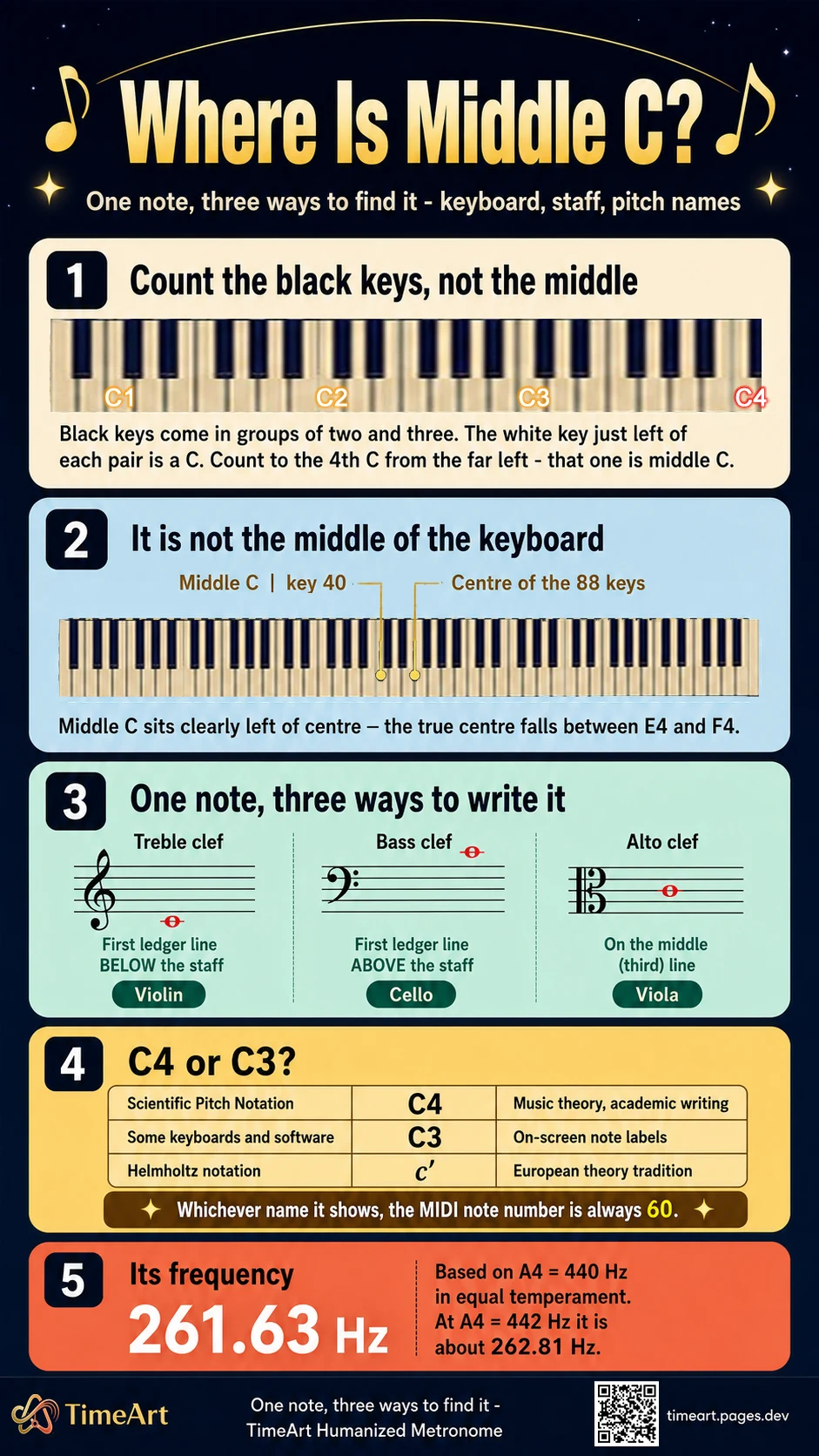
The reliable way to find it is not to look for the middle — it is to count black-key groups.

The four C's counted from the far left — the 4th one (red) is middle C
Use the black-key groups
Black keys alternate between groups of two and groups of three. The white key immediately left of each pair is a C. Starting from the far left of the keyboard, the 4th such C is middle C.
The lowest note of a standard 88-key piano is A0, so counting upward: C1 is key 4, C2 is key 16, C3 is key 28, and C4 (middle C) is key 40 — each octave is exactly 12 keys apart.
⚠️ It is not the centre of the keyboard
The name invites you to look in the middle, but that is not where it is. The true midpoint of 88 keys falls between keys 44 and 45 — that is between E4 and F4. Middle C is four white keys further left.
This also means that eyeballing the centre of a 61-key or 76-key keyboard will give you the wrong note — those instruments start and end elsewhere. Counting black-key groups always works.
𝄞 Where it is written on the staff three clefs
The same middle C is drawn in a completely different place in each clef. This is where most beginners get stuck.
| Clef | Where middle C sits | Relative to the staff | Common instruments |
|---|---|---|---|
| Treble (G clef) | First ledger line below | Outside, one line down | Violin, flute, right hand of piano |
| Bass (F clef) | First ledger line above | Outside, one line up | Cello, bassoon, left hand of piano |
| Alto (C clef) | The third line | Dead centre of the staff | Viola |
| Tenor (C clef) | The fourth line | Inside the staff | Upper cello range, trombone |
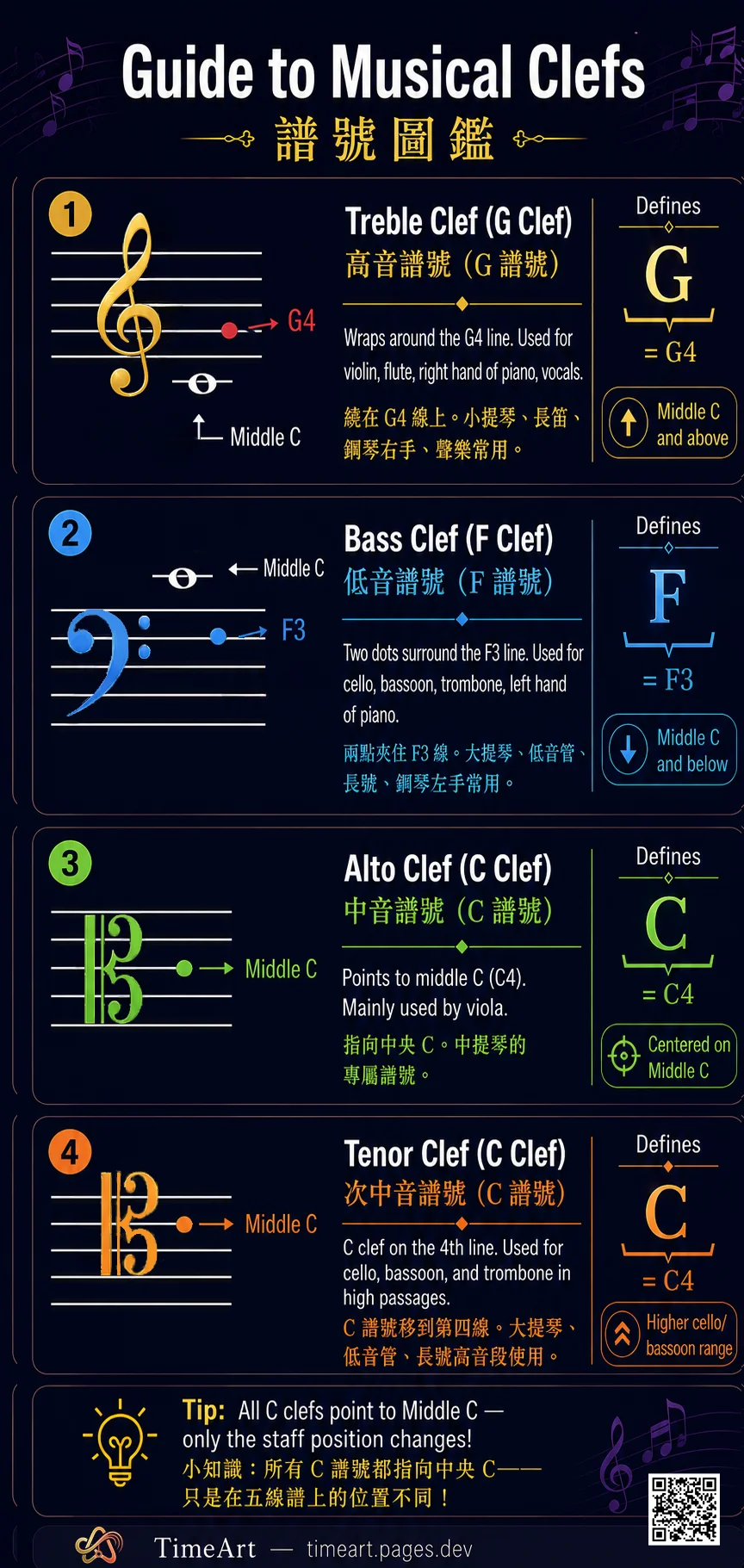
The four clefs and where middle C falls in each
On the grand staff the two halves meet there
The gap between the treble and bass staves of a piano score is exactly wide enough for one ledger line — and that line is middle C. Counting down from the upper staff gives "one ledger line below"; counting up from the lower staff gives "one ledger line above". Both land on the same place.
This is also why the viola reads alto clef: putting middle C on the centre line keeps the viola's working range inside the five lines, so it rarely needs ledger lines. Full guide to the clefs →
🔢 Why is it called C4 by some and C3 by others? two systems
This is the most common source of confusion. The pitch never changes — only the way octaves are numbered.
Three notations you will meet
| System | Middle C is written | Where you see it |
|---|---|---|
| Scientific Pitch Notation | C4 | Music theory, acoustics, academic writing |
| Some instruments and software | C3 | On-screen note labels |
| Helmholtz notation | c′ (one-line c) | European theory tradition, organ literature |
This site uses Scientific Pitch Notation, so middle C is C4. C3 is the octave below it and C5 the octave above.
⭐ One number never changes: MIDI 60
Whether the screen says C3, C4 or C5, middle C is always MIDI note number 60. Manufacturers disagree about which octave to call the zeroth one; the pitch itself has never moved.
So when a note name in your software does not match the printed score, the first thing to check is not the pitch — it is which octave numbering that software uses. It is usually a setting.
🎼 Frequency about 261.63 Hz
C4 ≈ 261.63 Hz
With A4 = 440 Hz in twelve-tone equal temperament, middle C works out to about 261.63 Hz. That figure is calculated, not decreed — it depends on the reference pitch.
Many orchestras tune to A4 = 442 Hz, which raises everything slightly: middle C then sits at about 262.81 Hz. So when sources quote slightly different numbers, it is usually the reference pitch that differs, not an error.
💬 Why it is called "middle" C
The name refers to the middle of the notation, not the middle of the keyboard. On a piano's grand staff, middle C falls on the ledger line between the treble and bass staves — the meeting point of the two systems. Above it is the right hand's territory; below it is the left hand's.
Sitting on that boundary is also why it is usually the first landmark beginners memorise: everything else can be counted up or down from there.
❓ Frequently asked
Is middle C the same as "do"?
In fixed do, C is always "do", so middle C is the middle "do". In movable do, "do" is the tonic and moves with the key — in G major, "do" is G, not C. Both systems are in use; it depends which one you were taught.
Is middle C key 40 on a 61-key keyboard too?
No. "Key 40" only holds for an 88-key piano, which starts at A0. Smaller keyboards begin and end on different notes. Use the black-key method instead: find the white key left of a pair of black keys, and count to the 4th one.
Why does my software show middle C as C3?
That is a different octave-numbering convention, not a wrong pitch. The MIDI note number is still 60, and most software lets you switch the display.
Why does viola music look like C is in the middle?
Because the viola reads alto clef, which is defined as "the third line is middle C". That keeps the viola's usual range inside the staff instead of piled onto ledger lines.
🖼 The whole thing in one image save it
Everything above, collected: keyboard position, the three clefs, C4 versus C3, and the frequency.