𝄞 The four clefs in use today modern scores
Each clef locks one note to one line. That note is your anchor for reading everything else.
| Clef | Family | Fixes | On which line | Common instruments |
|---|---|---|---|---|
| Treble | G clef | G4 | Second | Violin, flute, oboe, right hand of piano |
| Bass | F clef | F3 | Fourth | Cello, double bass, bassoon, left hand of piano |
| Alto | C clef | C4 (middle C) | Third | Viola |
| Tenor | C clef | C4 (middle C) | Fourth | Upper cello range, trombone, upper bassoon range |
Staff lines are always numbered from the bottom up — the lowest line is the first line.
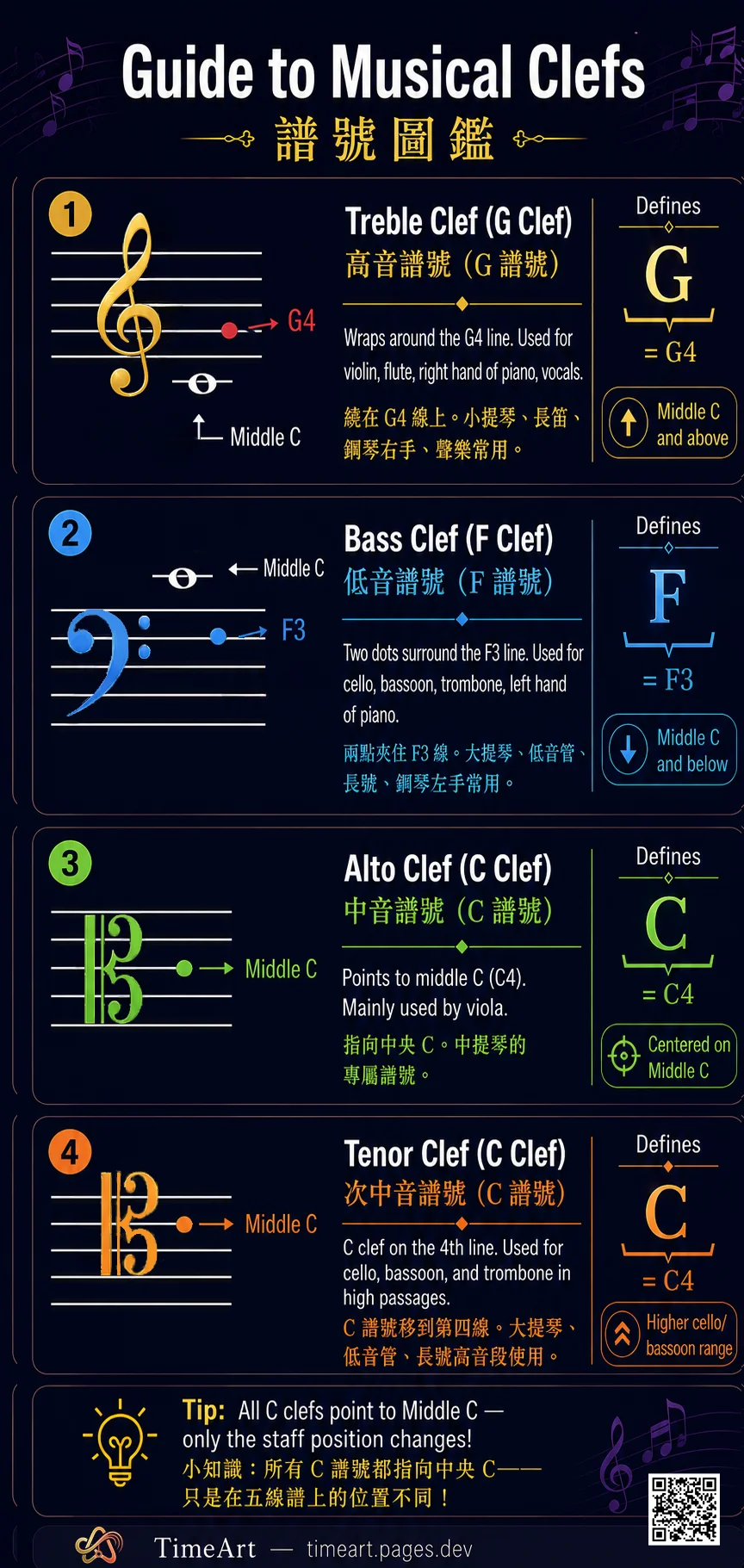
The four clefs and where middle C falls in each
🔑 There are really only three G / F / C
The four clefs look unrelated, but they are built from three symbols. The difference is which line the symbol is placed on.
The symbol itself points at the note
- G clef — the centre of the spiral curls around a line, and that line is G4. Placed on the second line it becomes the familiar treble clef.
- F clef — the two dots straddle a line, and that line is F3. Placed on the fourth line it becomes the bass clef.
- C clef — the point at its centre aims at a line, and that line is middle C. On the third line it is the alto clef; on the fourth, the tenor clef.
So "which clef is this?" really means "which line is this symbol sitting on?". Once that clicks, you can decode a clef you have never met before.
🎻 Why the viola reads alto clef fewer ledger lines
The viola's range sits between the violin and the cello. In treble clef its lower register would drop well below the staff; in bass clef its upper register would climb well above it. Either way you get a page full of ledger lines, which is tiring to read.
Alto clef puts middle C on the centre line, and the viola's working range then falls neatly inside the five lines. That is the entire reason it exists — clefs are chosen to make music easier to read, not harder.
Tenor clef works the same way
Cello, trombone and bassoon normally read bass clef, but when a passage climbs into the upper register the ledger lines pile up. Scores switch to tenor clef for those passages to bring the notes back inside the staff, then switch back afterwards.
So seeing two or three different clefs in one cello part is completely normal — it is not a printing error.
⇩ Clefs with a small 8
You will sometimes see a small 8 hanging below a treble clef. That means the music sounds one octave lower than written.
- Guitar — notated this way throughout, so a written middle C actually sounds an octave below middle C.
- Tenor voice — common in choral scores, to avoid a page of ledger lines.
An 8 placed above the clef means the opposite — sounding an octave higher — though that is much rarer. Check which side the number is on; the meaning flips.
⚠️ Do not confuse this with transposing instruments. When a clarinet or horn sounds a different pitch from what is written, that comes from the instrument's key, not from a number attached to the clef.
📜 Historically there were more older scores
A C clef can sit on any of the five lines, and every position once had its own name:
| Name | C clef on | Historical use |
|---|---|---|
| Soprano clef | First line | Older vocal scores, soprano part |
| Mezzo-soprano clef | Second line | Older vocal scores |
| Alto clef | Third line | Still in use (viola) |
| Tenor clef | Fourth line | Still in use (upper cello, trombone) |
| Baritone clef | Fifth line | Older scores; also written as an F clef on the third line |
Modern published editions keep only alto and tenor. The others turn up in manuscripts, early editions and some scholarly editions.
💡 How to read an unfamiliar clef
Three steps
- 1. Identify the family — a spiral is G, two dots are F, a symmetrical bracket shape is C.
- 2. Find the line it locks — the centre of the spiral, the gap between the dots, or the point of the bracket.
- 3. Count outward from that line — line, space, line, space are consecutive scale steps.
Early on it helps to memorise a single anchor (for example, the second line of the treble clef is G) and count everything else. Speed comes from reading a lot of music, and does not need to be forced.
❓ Frequently asked
Why does piano music have two staves but violin music only one?
The piano covers a very wide range with two hands, so it uses a grand staff — treble above, bass below, with middle C at their meeting point. The violin's range sits in the upper region, so one treble staff is enough.
Can the clef change in the middle of a piece?
Yes, and it often does. Cello, trombone and bassoon parts switch to tenor or treble clef for high passages to reduce ledger lines. The new clef is drawn at the point where the change happens.
Why does percussion notation look different?
Unpitched percussion uses a neutral clef, usually drawn as two thick vertical bars. It does not indicate pitch at all — each line or space simply stands for a different instrument or playing position.
Is "C clef" the same as "alto clef"?
Not quite. "C clef" is the family; the alto clef is that symbol placed specifically on the third line. Placed on the fourth line the same symbol is the tenor clef.